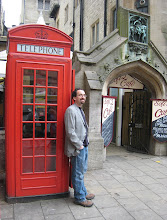
You would think that, being someone who travels a lot, I would know all the secrets and tricks of the savvy traveler. Sadly, no. This week, in fact, I fell into one of the traps that the airlines plant for unsuspecting travelers and I ended up getting home to Oxford about 12 hours delayed and extremely grumpy.
My first mistake was breaking one of the obvious rules of travel: always take a direct flight. Tempted by the much much lower cost of a connecting flight, I was supposed to take an afternoon hop from Newark to DC Dulles (United Express) and then catch an overnight flight (United International) to London Heathrow and be back at Oxford by 6am. The lower cost is great, but when things start to go wrong, a missed connection can add hours if not days to your travel time, as well as taking years off your life in stress.
Anyway, on the day of the flight there was some rain and the United connections from Newark to Dulles were all delayed. I got to the airport almost three hours early, but there was no room on any earlier United flight to Dulles so it looked likely I would miss Dulles-London, and there seemed to be no space on later flights because everyone was being bumped around due to the weather and open slots were already filled. The woman behind the desk said that there were several options
(1) Get to Dulles late and hope for standby on a later Dulles-London
(2) Just go home and have the ticket pushed to tomorrow
(3) A flight on Alitalia connecting through Rome that should get me to Heathrow only about four hours late.
Of these three option, (3) actually sounded like it was the best. I had meetings in Oxford that I really wanted to keep, and a four hour delay, while not optimal, sounded pretty good --- I would still be there in plenty of time. And so the woman behind the desk made the change.
And that was my second mistake.
Here’s the rub: Once the ticket is transferred to Alitalia, United has washed their hands of the situation. Options (1) and (2) vanish immediately. The ticket belongs to Alitalia, which has far fewer flights going to London. Although Alitalia was not admitting it at the time when we made the transfer of the ticket, their flight was going to be delayed too… which meant that I would miss my connection in Rome. As soon as I got to the Alitalia ticket counter, I knew I had made a mistake – and there was no way to fix the problem. Alitalia would not budge. They owned the ticket, and they would get me to London to make good on the ticket --- they just had no way to do it very efficiently. Going through Rome was not optimal to begin with, but now I was stuck with it, even though it was clear that I would miss the connection and then be stuck in Rome for quite a while longer.
I won't even bother to complain about not being able to sleep on the flight. I made it home to Oxford at about 7pm that day. 12 hours delayed. Grrr.
Next time I'll know better.


Last week, I gave a talk at Microsoft station Q. In an earlier post, I mentioned that I was a bit afraid of giving this talk as the topic pushed rather deep into fields of mathematics that I have very little knowledge of. Here is a pretty picture from the talk.

(The picture was made with a public domain plotting program called POV-Ray which is very easy to use. I highly recommend it. It is to most graphics programs what LaTeX is to word processing.)
First of all, my apologies to many of the people who showed up to listen to the talk and felt that they were snowed by the relatively mathematical content. I had the talk calibrated for the station Q audience (people who are not afraid of mathematical words like "modular tensor category" and "Dehn surgery") and I did not expect it to be so well attended by more general physicists from outside of Q. Then, once the talk was prepared and in motion, I didn't know how to make it more user-friendly on the fly. I felt really badly about this: I personally hate it when a speaker talks to only a small subset of their audience. I find it annoying and rude, and I frequently walk out of such talks. So I feel badly that I was certainly doing exactly that. I promise to try to construct a more accessible version of this talk for the future. I think it is a pretty cool topic once you cut through the formalism just a bit.
OK, now for a brief description of the talk. The above pretty picture is a geometric construction known as “Chain Mail” invented by Justin Roberts in the mid 1990s. The rough idea is to get information about the 3 dimensional manifold of space you are living in. You break the manifold of space into cells (cubes in the picture) and you wrap a string around each plaquette of each cell (These are the longer darker strings) then you tie the strings together with other strings (the shorter lighter strings). Now view all these strings as a complicated knot (or more properly a link, since it is a knot with many strands). Then you evaluate a property of the knot such as its Jones polynomial, Kauffman invariant or the like. The result is independent of the details of the decomposition of space and gives you information about the structure of your manifold. In fact, it gives you precisely the so-called Turaev-Viro invariant (A theorem by Turaev and Walker tells us that this is the square of a Chern-Simons partition function. The theorem is proved in about three lines using the chain-mail construction). It turns out that this construction can also be shown to be equivalent to the Levin-Wen construction of topological lattice models -- the chain mail picture is interpreted as a 2+1 dimensional space-time diagram. This is what my talk was about. This equivalence gives you a very physical understanding of why the Levin-Wen construction ends up giving you a doubled (achiral) theory. (This work is collaboration with Fiona Burnell, who has been mentioned several times on this blog).
I had posted earlier that I was afraid that Mike Freedman or Kevin Walker would find some hole in my argument. They did indeed manage to find an error in the argument, but it turns out to be very minor and easily fixable. I had some good discussions with both of them after the talk and this made me think that perhaps we really did have something interesting to say.

(The picture was made with a public domain plotting program called POV-Ray which is very easy to use. I highly recommend it. It is to most graphics programs what LaTeX is to word processing.)
First of all, my apologies to many of the people who showed up to listen to the talk and felt that they were snowed by the relatively mathematical content. I had the talk calibrated for the station Q audience (people who are not afraid of mathematical words like "modular tensor category" and "Dehn surgery") and I did not expect it to be so well attended by more general physicists from outside of Q. Then, once the talk was prepared and in motion, I didn't know how to make it more user-friendly on the fly. I felt really badly about this: I personally hate it when a speaker talks to only a small subset of their audience. I find it annoying and rude, and I frequently walk out of such talks. So I feel badly that I was certainly doing exactly that. I promise to try to construct a more accessible version of this talk for the future. I think it is a pretty cool topic once you cut through the formalism just a bit.
OK, now for a brief description of the talk. The above pretty picture is a geometric construction known as “Chain Mail” invented by Justin Roberts in the mid 1990s. The rough idea is to get information about the 3 dimensional manifold of space you are living in. You break the manifold of space into cells (cubes in the picture) and you wrap a string around each plaquette of each cell (These are the longer darker strings) then you tie the strings together with other strings (the shorter lighter strings). Now view all these strings as a complicated knot (or more properly a link, since it is a knot with many strands). Then you evaluate a property of the knot such as its Jones polynomial, Kauffman invariant or the like. The result is independent of the details of the decomposition of space and gives you information about the structure of your manifold. In fact, it gives you precisely the so-called Turaev-Viro invariant (A theorem by Turaev and Walker tells us that this is the square of a Chern-Simons partition function. The theorem is proved in about three lines using the chain-mail construction). It turns out that this construction can also be shown to be equivalent to the Levin-Wen construction of topological lattice models -- the chain mail picture is interpreted as a 2+1 dimensional space-time diagram. This is what my talk was about. This equivalence gives you a very physical understanding of why the Levin-Wen construction ends up giving you a doubled (achiral) theory. (This work is collaboration with Fiona Burnell, who has been mentioned several times on this blog).
I had posted earlier that I was afraid that Mike Freedman or Kevin Walker would find some hole in my argument. They did indeed manage to find an error in the argument, but it turns out to be very minor and easily fixable. I had some good discussions with both of them after the talk and this made me think that perhaps we really did have something interesting to say.
I thought that after one term I knew most of the crucial Oxford terminology: Winter term is Hilary, spring is Trinity, Fall is Michaelmas. Magdalen college is pronounced “Mawdlen”, and I learned what “Desummoned” means here.
Then I got an email that completely baffled me “Please let me know if you need your collection invigilated”. Huh?
Well, “Collection” is the Oxford word for the exams that occur at the beginning of Hilary and Trinity to make sure that the students are learning what they are supposed to be learning and that they are studying over the break (collections do not really count on the student’s final record). “Invigilate”: I confess, I did not know this word, but indeed it is even in Webster’s (OED also includes this word, but that is not evidence of anything, since OED seems to list every bit of babble anyone has ever uttered).
Then I got an email that completely baffled me “Please let me know if you need your collection invigilated”. Huh?
Well, “Collection” is the Oxford word for the exams that occur at the beginning of Hilary and Trinity to make sure that the students are learning what they are supposed to be learning and that they are studying over the break (collections do not really count on the student’s final record). “Invigilate”: I confess, I did not know this word, but indeed it is even in Webster’s (OED also includes this word, but that is not evidence of anything, since OED seems to list every bit of babble anyone has ever uttered).
in•vig•i•late \in-ˈvi-jə-ˌlāt\ verb in•vig•i•lat•ed; in•vig•i•lat•ingSo there you have it. I’m not sure if this is standard British usage or if it is Oxbridge specific. (Any non-Oxbridge Brits want to comment?). I have to assume that the American analog “Proctor” would sound like an unpleasant medical procedure?
Latin invigilatus, past participle of invigilare to stay awake, be watchful, from in- + vigilare to stay awake. First usage 1553
intransitive verb: to keep watch ; especially British : to supervise students at an examination. transitive verb: supervise, monitor
Wednesday, April 15, 2009
Experimental Progress --- Maybe
Labels:
General Nonsense,
Physics,
Physics for Poets
On the topic of station Q: Back in December I blogged about how we all want the station Q project to be a smashing success, so our field of science will prosper. I wrote in particular about two experimental efforts trying to observe “nonabelions” in nature. Last week, my collaborator, Woowan Kang (for entertainment, see this video of Woowan), gave a status report on his experiments at KITP. You can see it here if you like. I think this talk went over a bit better than the last time he tried to give it, back in December. At the very least there was a bit of statistical analysis and sanity checks on the data this time. I’m still can’t tell if he is seeing complete crap, or something very interesting. I’m both hopeful and fearful, but I’m trying to keep an open mind in the situation until the story is really solid one way or the other.
Simultaneously, there has been new data from Bob Willett back at the old Alcatel-Lucent ranch. You can see some of the data here. The data he showed in December is roughly v1 of this paper. There is additional data even more recent than v2 of the paper also which is not on the web. Again, the data is not completely solid one way or the other, although it is very suggestive. There has already been a theory paper here analyzing his data. However, there are some serious puzzles with the data too. Maybe that makes it even more interesting… or maybe that tells us that we are barking up the wrong tree. Stay tuned in the next few months/years for the stunning conclusion.
Simultaneously, there has been new data from Bob Willett back at the old Alcatel-Lucent ranch. You can see some of the data here. The data he showed in December is roughly v1 of this paper. There is additional data even more recent than v2 of the paper also which is not on the web. Again, the data is not completely solid one way or the other, although it is very suggestive. There has already been a theory paper here analyzing his data. However, there are some serious puzzles with the data too. Maybe that makes it even more interesting… or maybe that tells us that we are barking up the wrong tree. Stay tuned in the next few months/years for the stunning conclusion.
When I start work on a new scientific project, it is like arriving in a new city. At first everything is strange and frustrating. Then you start wandering around a bit. After a while, you come back to some point you have seen before and it makes you feel happy that you recognize something. So you start building a neighborhood of knowledge around one topic that you understand. Then maybe you take the subway somewhere else and start over again learning about another neighborhood. After a while the neighborhoods of knowledge grow and start to connect together and you get a perspective of what the whole city looks like. Eventually you feel like a native.
Of course*, it is always easier to build on your current knowledge, and not leave the comfortable city that you live in. But if you always do this, you get stagnant and end up too focused on minutia of your current specialty. So once in a while it is good to jump into the deep end and learn something really different
Is this a metaphor for my move across the ocean? I’ll leave that to the reader to decide.
But in truth, when I sat down to write this blog entry, I was thinking more on the scientific front. Over the last five or six years, with a fair amount of pain, I have delved into the rather mathematical field of topological field theories and conformal field theories. I had essentially no background in type of physics, and it was very hard going at first. Now, I am finally at the point where neighborhoods are starting to look familiar and, perhaps, I can think of myself as a native. Albeit one who still gets lost pretty often.
*footnote: Yes, of course, I know I use the phrase “of course” too often.
Of course*, it is always easier to build on your current knowledge, and not leave the comfortable city that you live in. But if you always do this, you get stagnant and end up too focused on minutia of your current specialty. So once in a while it is good to jump into the deep end and learn something really different
Is this a metaphor for my move across the ocean? I’ll leave that to the reader to decide.
But in truth, when I sat down to write this blog entry, I was thinking more on the scientific front. Over the last five or six years, with a fair amount of pain, I have delved into the rather mathematical field of topological field theories and conformal field theories. I had essentially no background in type of physics, and it was very hard going at first. Now, I am finally at the point where neighborhoods are starting to look familiar and, perhaps, I can think of myself as a native. Albeit one who still gets lost pretty often.
*footnote: Yes, of course, I know I use the phrase “of course” too often.
Although it is hard to complain about the sunshine of Santa Barbara, life at KITP isn’t all beach volleyball – I’ve actually been working pretty hard out here. In addition to doing research (the physics kind, not the beach volleyball kind), in the span of only two weeks I am giving three talks on three totally different topics – and none of them are canned talks that I can give without much additional preparation.
Today’s talk is probably the most accessible of the three: “Topological Phases of Matter, Interesting and Useful”. It is posted on the web here. This talk is aimed at physicists not necessarily in my field. Anyone with an undergrad level education in physics should have a fair chance of understanding most of it. I recommend it for the curious. [Note added: About 7-8 minutes in, strictly speaking I make a mathematical mistake. See below for a description of the mistake]
Last Thursday I gave this talk. It has already been commented that to non-scientists I look completely silly wearing a sports jacket over a peanuts t-shirt, but amongst physicists this is not seen as strange. The topic of the talk is quantum Hall bilayers – the nu=1/2 +1/2 problem. This is a somewhat specialized talk and probably only the hbar condensed matter physicists will find it interesting or accessible. About 51-52 minutes into the talk I get busted trying to give a quick proof of a complicated fact, and the proof turns out to be wrong. (Matthew Fisher was the one who caught it immediately). I realized right away that the argument was crap. Nonetheless, it was a bit of a red-faced moment. It doesn’t matter too much though, because you can prove the result in a more complicated way.
(For the physicists reading this, I was trying to give a two line proof that a px+ipy spin triplet superconductor has quantum spin Hall effect. There is a detailed proof in Read and Green PRB 2000, but it is not particularly simple. There is probably a cleaner way to prove it based on following the band structure and discovering one putatively localized band stretches across the system, but I haven’t worked this through – it has probably been done by someone already anyhow. Also for the interested physicist, this talk was based on two recent papers with Gunnar Moller and Ed Rezayi. The papers are here and here).
Next Wednesday I give a talk across the street at Microsoft Station Q. The topic of this talk is the project I’ve been working on with Fiona Burnell. I confess I’m a bit frightened about giving this talk – probably for good reason: Our arguments wander off into four dimensional topology before returning to physics, and one of the people in the audience will be Michael Freedman – who has a Field’s medal for work in four dimensional topology. If there is anyone in the world who will be able to instantly see weaknesses of our work, it is likely to be him. Even more frightening is the possibility that he (or someone else at station Q, possibly Kevin Walker) says, “oh yes, this is all known”. I’ll keep you updated on how this goes. At some point I’ll try to explain roughly what we are doing, but right now we don’t have all that simple a version.
[Added note from above: Regarding the mistake I mention above. Zhenghan Wang, a very good mathematician, points out that it is not true that no knot invariant exists that can distinguish all knots from each other. I define a knot invariant as any map from a knot as in input to any output. A trivial example, strictly speaking, is the identity map. Unfortunately, it is just as hard to compare the outputs as it was to compare the original knots. Nonetheless, to be precise, it is true that the output of the identity map distinguishes all knots from each other. A less trivial example is that the compliment of the knot within the manifold S3 also fully distinguishes all knots].
Today’s talk is probably the most accessible of the three: “Topological Phases of Matter, Interesting and Useful”. It is posted on the web here. This talk is aimed at physicists not necessarily in my field. Anyone with an undergrad level education in physics should have a fair chance of understanding most of it. I recommend it for the curious. [Note added: About 7-8 minutes in, strictly speaking I make a mathematical mistake. See below for a description of the mistake]
Last Thursday I gave this talk. It has already been commented that to non-scientists I look completely silly wearing a sports jacket over a peanuts t-shirt, but amongst physicists this is not seen as strange. The topic of the talk is quantum Hall bilayers – the nu=1/2 +1/2 problem. This is a somewhat specialized talk and probably only the hbar condensed matter physicists will find it interesting or accessible. About 51-52 minutes into the talk I get busted trying to give a quick proof of a complicated fact, and the proof turns out to be wrong. (Matthew Fisher was the one who caught it immediately). I realized right away that the argument was crap. Nonetheless, it was a bit of a red-faced moment. It doesn’t matter too much though, because you can prove the result in a more complicated way.
(For the physicists reading this, I was trying to give a two line proof that a px+ipy spin triplet superconductor has quantum spin Hall effect. There is a detailed proof in Read and Green PRB 2000, but it is not particularly simple. There is probably a cleaner way to prove it based on following the band structure and discovering one putatively localized band stretches across the system, but I haven’t worked this through – it has probably been done by someone already anyhow. Also for the interested physicist, this talk was based on two recent papers with Gunnar Moller and Ed Rezayi. The papers are here and here).
Next Wednesday I give a talk across the street at Microsoft Station Q. The topic of this talk is the project I’ve been working on with Fiona Burnell. I confess I’m a bit frightened about giving this talk – probably for good reason: Our arguments wander off into four dimensional topology before returning to physics, and one of the people in the audience will be Michael Freedman – who has a Field’s medal for work in four dimensional topology. If there is anyone in the world who will be able to instantly see weaknesses of our work, it is likely to be him. Even more frightening is the possibility that he (or someone else at station Q, possibly Kevin Walker) says, “oh yes, this is all known”. I’ll keep you updated on how this goes. At some point I’ll try to explain roughly what we are doing, but right now we don’t have all that simple a version.
[Added note from above: Regarding the mistake I mention above. Zhenghan Wang, a very good mathematician, points out that it is not true that no knot invariant exists that can distinguish all knots from each other. I define a knot invariant as any map from a knot as in input to any output. A trivial example, strictly speaking, is the identity map. Unfortunately, it is just as hard to compare the outputs as it was to compare the original knots. Nonetheless, to be precise, it is true that the output of the identity map distinguishes all knots from each other. A less trivial example is that the compliment of the knot within the manifold S3 also fully distinguishes all knots].
Back in 1979 a bunch of theoretical physicists had a brilliant idea. This idea was not an idea about physics, but an idea about where one should think about physics – on the beach. These physicists decided that what the world really needed was a major theoretical physics research center located right on the ocean in Santa Barbara. To this end they founded the Institute for Theoretical Physics (ITP). The idea would be to have a very few high profile physicists as permanent academic staff, and organize rolling conferences on interesting topics that would run for months at a time. Theoretical physicists from around the world would come to visit Santa Barbara for weeks or months, they would discuss physics with each other, and they would be inspired by the beautiful environs. The idea worked wonderfully. Who wouldn’t want to spend a sabbatical by the ocean? Within a decade UCSB had established itself as one of the world’s major centers of theoretical physics – if not the major center. In 2002, the already successful ITP got a huge donation from the Kavli foundation to expand, and was rechristened the KITP.
The organization of the KITP is really phenomenal. They arrange workshops, conferences, housing, and take care of all of the mundane needs of the researchers. When you arrive you are given an office in the KITP and you go to work. If you are lucky (or have friends in high places) you get an office that overlooks the beautiful ocean. (This year, I got an ocean view for the first time). There are chalkboards all over the place for spontaneous discussions, cookies at 3pm every day, and coffee, tea, and hot chocolate cost only 10$ for a three week subscription. If you need to clear your mind, you can go for a walk or a run along the beach. Or you can walk down to Isla-Vista to go to the student haunts (there is a great burrito shop and a great sandwich shop there).
This place is like summer camp for nerds. I’ll be here for the next three weeks. I’m already inspired by the sunshine.
Added: This morning I was at the KITP for sunrise (yeah, I'm kind of still on UK time). Looking out my window I saw dolphins, herons, hummingbirds, and all sorts of other things that I don't know the name of. Tough life, huh?
The organization of the KITP is really phenomenal. They arrange workshops, conferences, housing, and take care of all of the mundane needs of the researchers. When you arrive you are given an office in the KITP and you go to work. If you are lucky (or have friends in high places) you get an office that overlooks the beautiful ocean. (This year, I got an ocean view for the first time). There are chalkboards all over the place for spontaneous discussions, cookies at 3pm every day, and coffee, tea, and hot chocolate cost only 10$ for a three week subscription. If you need to clear your mind, you can go for a walk or a run along the beach. Or you can walk down to Isla-Vista to go to the student haunts (there is a great burrito shop and a great sandwich shop there).
This place is like summer camp for nerds. I’ll be here for the next three weeks. I’m already inspired by the sunshine.
Added: This morning I was at the KITP for sunrise (yeah, I'm kind of still on UK time). Looking out my window I saw dolphins, herons, hummingbirds, and all sorts of other things that I don't know the name of. Tough life, huh?
Subscribe to:
Posts (Atom)