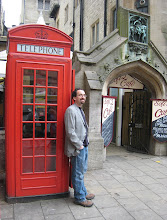
Today it snowed a bit. And everyone had a complete nervous breakdown. I guess they don't get a whole lot of snow that sticks around here. It was huge news in London where they basically shut down the city. But to be fair to the Brits, this was apparently the heaviest snow in 18 years. In Oxford the snow was somewhat lighter -- but enough to be pretty. You can see Somerville College in the snow here. Later in the day, there were snowball fights and snowmen. Am I an old curmudgeon for not participating in the snowball fights?
Update: Two days later we actually had about four inches -- and the city came to a halt. People recalled back to "that great snow of 1947" and "that time it snowed a foot in 1962". I guess it really is pretty rare around here.


Since I am somewhat allergic to formal events I had been avoiding the high table dinners at Somerville College. However, a few people recommended that I might want to go to this week because it was something a bit out of the ordinary.
This week was a celebration of Burns Night – the birthday of the Scottish poet Robert Burns (he wrote Auld Lang Syne among other things). In fact, this year would be his 250th birthday. Although the actual holiday is January 25th, our college celebrated it on Tuesday the 27th , as Tuesday is the day we usually have high table dinners.
As is typical for high table dinners, there are drinks before dinner in the senior common room. I went with the sherry, which was decent, although not exceptional (Note to self: get invited to the filthy rich colleges for dinner more often so I can get some of that 80 year old wine).
The fellows walk into the great hall led by a bagpiper and everyone stands until the latin grace is said by the Principal of the College. The undergrads were dressed very well, perhaps better than most the faculty. A few were even in black tie. As usual, the dopey American physicist (that would be me) was underdressed. I was wearing a tweed jacket a white shirt and to quote my ex-girlfriend “those pants that you think are nice, but they aren’t”. I had asked whether I needed a tie, and the response was “Well, you can get away without”, so I went without – then realized this was a mistake. The phrase “you can get away without” might have meant, “well, you might get away without, but I would never dream of going without a tie”. There was only one other tieless guy in the room of over a hundred – a mathematician.
As I have mentioned in previous posts, Somerville is considered “modern” because we do not eat in academic robes. But this has the disadvantage, that people actually see what you are wearing. All told, I think I am happy we do not eat in robes, as I cannot imagine how I could possibly not get the sleeves in my soup.
Many of the people who showed up for this dinner were Scottish. By the grace of the seating chart (not sure who makes it up) I was placed next to a Scottish woman (who was actually a guest of said tieless mathematician who sat across from me). She explained to me that the Scotts Scots around would probably go to five or six different Burns Night celebrations each year. She had two to go to just that evening.
This web site has a pretty good description of the traditional Burns Night supper and all the traditions. The highlight, without doubt, is the Addressing of the Haggis. An enormous Haggis is brought into the great hall with much fanfare (led by the bagpiper again), and placed on the table. The Burns poem “Address to a Haggis” is read as if speaking to the Haggis, a knife is plunged into the object, and a toast is made with Scottish whiskey (the Scotts Scots woman next to me was mortified that it was a blend rather than a single malt Scotch).
The addressing of the Haggis was done by one of the college fellows who is extremely Scottish and has a very hard Glaswegian accent. I then realized that in normal conversation she works very hard to speak in an understandable way, but her natural Glaswegian is almost incomprehensible. Of course, Burns’ poem itself is not so easy to understand to begin with. In fact, one really needs a translation from Scottish to English (one is given here). Even though many in the room (including me) had no idea what she was saying, the address was given with great fanfare and great Scottish gusto.
Dinner itself was, of course, Haggis, along with the traditional neeps and tatties. Tatties, of course are just mashed potatoes. Neeps are mashed swede (rutabaga or yellow turnip) which tastes half way in between a potato and a squash.
I admit that I feared that Haggis. I’d only eaten Haggis once, years ago when I was up in Scotland – and it was pretty awful – tasted too much like liver. But this Haggis was actually pretty good (and served without the sheep's stomach) – pretty much like a decent meatloaf– which I guess is more or less what it is (although the “loaf” is traditionally oats, as compared to usual loaf). They also had vegetarian Haggis (soy loaf, I guess) for those who preferred. I didn’t try that, but I’m told it wasn’t half bad. Dessert was oatmeal and honey ice cream. Very tasty, but by this time in the meal, something as heavy as oatmeal didn’t sound like a very good idea.
Of course after dinner the “adults” return to the senior common room for more wine, fruit, chocolate, coffee, tea and socializing. I stuck around for a bit, but couldn’t stay too late as I had homeworks to grade for my students by the next day.
This week was a celebration of Burns Night – the birthday of the Scottish poet Robert Burns (he wrote Auld Lang Syne among other things). In fact, this year would be his 250th birthday. Although the actual holiday is January 25th, our college celebrated it on Tuesday the 27th , as Tuesday is the day we usually have high table dinners.
As is typical for high table dinners, there are drinks before dinner in the senior common room. I went with the sherry, which was decent, although not exceptional (Note to self: get invited to the filthy rich colleges for dinner more often so I can get some of that 80 year old wine).
The fellows walk into the great hall led by a bagpiper and everyone stands until the latin grace is said by the Principal of the College. The undergrads were dressed very well, perhaps better than most the faculty. A few were even in black tie. As usual, the dopey American physicist (that would be me) was underdressed. I was wearing a tweed jacket a white shirt and to quote my ex-girlfriend “those pants that you think are nice, but they aren’t”. I had asked whether I needed a tie, and the response was “Well, you can get away without”, so I went without – then realized this was a mistake. The phrase “you can get away without” might have meant, “well, you might get away without, but I would never dream of going without a tie”. There was only one other tieless guy in the room of over a hundred – a mathematician.
As I have mentioned in previous posts, Somerville is considered “modern” because we do not eat in academic robes. But this has the disadvantage, that people actually see what you are wearing. All told, I think I am happy we do not eat in robes, as I cannot imagine how I could possibly not get the sleeves in my soup.
Many of the people who showed up for this dinner were Scottish. By the grace of the seating chart (not sure who makes it up) I was placed next to a Scottish woman (who was actually a guest of said tieless mathematician who sat across from me). She explained to me that the
This web site has a pretty good description of the traditional Burns Night supper and all the traditions. The highlight, without doubt, is the Addressing of the Haggis. An enormous Haggis is brought into the great hall with much fanfare (led by the bagpiper again), and placed on the table. The Burns poem “Address to a Haggis” is read as if speaking to the Haggis, a knife is plunged into the object, and a toast is made with Scottish whiskey (the
The addressing of the Haggis was done by one of the college fellows who is extremely Scottish and has a very hard Glaswegian accent. I then realized that in normal conversation she works very hard to speak in an understandable way, but her natural Glaswegian is almost incomprehensible. Of course, Burns’ poem itself is not so easy to understand to begin with. In fact, one really needs a translation from Scottish to English (one is given here). Even though many in the room (including me) had no idea what she was saying, the address was given with great fanfare and great Scottish gusto.
Dinner itself was, of course, Haggis, along with the traditional neeps and tatties. Tatties, of course are just mashed potatoes. Neeps are mashed swede (rutabaga or yellow turnip) which tastes half way in between a potato and a squash.
I admit that I feared that Haggis. I’d only eaten Haggis once, years ago when I was up in Scotland – and it was pretty awful – tasted too much like liver. But this Haggis was actually pretty good (and served without the sheep's stomach) – pretty much like a decent meatloaf– which I guess is more or less what it is (although the “loaf” is traditionally oats, as compared to usual loaf). They also had vegetarian Haggis (soy loaf, I guess) for those who preferred. I didn’t try that, but I’m told it wasn’t half bad. Dessert was oatmeal and honey ice cream. Very tasty, but by this time in the meal, something as heavy as oatmeal didn’t sound like a very good idea.
Of course after dinner the “adults” return to the senior common room for more wine, fruit, chocolate, coffee, tea and socializing. I stuck around for a bit, but couldn’t stay too late as I had homeworks to grade for my students by the next day.
I made a quick visit to Cambridge this week to visit the famous Cavendish lab and give this seminar. I saw quite a number of old friends and was introduced to some new people too, and managed to discuss a whole lot of interesting physics in a very short time.
The trip from Oxford to Cambridge is not that far as the crow flies (about 80 miles), but there is no convenient way to get from one to the other. By car, it is a very complicated route and takes two and a half hours. By bus, more than three, and more than one person warned me that it is a bus ride that is sure to make anyone nauseated, because the bus goes around about a hundred roundabouts (known as a traffic circle, or rotary in the united state). By train, which is probably the best way to get from one to the other, you have to go into London Paddington Station, then take the tube to London Kings Cross (*see footnote below), then train to Cambridge. It makes the journey rather a schlep.
While I could wax poetic about some of the physics that is going on at the Cavendish, I think I may have used my quota of physics talk allowed on this blog last week, so instead I will mention something else I learned while I was there:
After a long day of physics, I was invited to High Table dinner at Cambridge’s Pembroke College. Unlike Somerville at Oxford, Pembroke, founded in 1300-something, has a proper High Table where even the students wear gowns to dinner. During this dinner, the old scholar sitting across from me was extremely excited about having recently discovered the first usage of a particular common phrase. He had been reading a text called “The true history and chronicle of King Leir” which was more or less the source for much of the great Bard’s play, and had come across a common expression and was wise enough to realize that this was probably its earliest recorded usage. Being that the scholar sitting across from me was probably about 90 years old, it is rather appropriate that the expression in questions was “One foot in the grave. ” He did admit that it was a bit of an autobiographical discovery.
*Footnote: Last time I was at King’s Cross, I found that there really is a platform nine and three quarters, but I did not manage to find it this time. I hope it is still there.
The trip from Oxford to Cambridge is not that far as the crow flies (about 80 miles), but there is no convenient way to get from one to the other. By car, it is a very complicated route and takes two and a half hours. By bus, more than three, and more than one person warned me that it is a bus ride that is sure to make anyone nauseated, because the bus goes around about a hundred roundabouts (known as a traffic circle, or rotary in the united state). By train, which is probably the best way to get from one to the other, you have to go into London Paddington Station, then take the tube to London Kings Cross (*see footnote below), then train to Cambridge. It makes the journey rather a schlep.
While I could wax poetic about some of the physics that is going on at the Cavendish, I think I may have used my quota of physics talk allowed on this blog last week, so instead I will mention something else I learned while I was there:
After a long day of physics, I was invited to High Table dinner at Cambridge’s Pembroke College. Unlike Somerville at Oxford, Pembroke, founded in 1300-something, has a proper High Table where even the students wear gowns to dinner. During this dinner, the old scholar sitting across from me was extremely excited about having recently discovered the first usage of a particular common phrase. He had been reading a text called “The true history and chronicle of King Leir” which was more or less the source for much of the great Bard’s play, and had come across a common expression and was wise enough to realize that this was probably its earliest recorded usage. Being that the scholar sitting across from me was probably about 90 years old, it is rather appropriate that the expression in questions was “One foot in the grave. ” He did admit that it was a bit of an autobiographical discovery.
*Footnote: Last time I was at King’s Cross, I found that there really is a platform nine and three quarters, but I did not manage to find it this time. I hope it is still there.
The British college education system is quite different from that in the United States. First of all, you go to college to study only one topic (or “Read” the topic, as they say here). So, upon leaving high school, a student will apply to Oxford to Read Physics, and then when they get here, it is all Physics all the time for the length of their college career. Liberal Arts does not really exist over here (or in most of Europe for that matter). On the one hand, it risks developing people who are very one-sided. On the other hand, students coming out of this system can be extremely well prepared in their chosen subject.
The second difference is in how students are examined. As far as I can tell there are only two examinations in the entire student’s career. One exam, the “prelim”, at the end of the first year. This is basically a chance to fail out if you are really doing badly (very very few fail). It also stratifies the class a bit into those who are doing well and those who are not. In the case of physics, there is a three year degree and a four year degree, and if you do badly on the prelim, you can’t get the four year degree. The only other exam you have is the final exam at the end of your career. And that’s all. Of course, having only two exams means that some students can procrastinate learning for years – but most actually do try very hard to keep up – or at least the physics students do. These exams are not written by the people who taught the courses, but rather are put together by an exam committee to test what is supposed to be on the curriculum (which is decided by a curriculum committee). Apparently being on either of these committees is something to be avoided, as they inevitably result in fights.
The third difference is in how the classes are actually taught. There is one person who gives lectures to the entire class of 180 first year physics students. However much of the teaching is actually done by the tutor. Homeworks are assigned and graded by tutors, as well as mock exams (known as “collections”) – and the tutors may or may not be in sync with what the lecturer is doing. Both the tutors and the lecturers are both trying to teach the curriculum (and prepare the student for the real exam) but they are free to do so in different ways. In physics students typically meet with their tutors in a two-on-one setting roughly for an hour every other week per course. This adds up to a whole lot of individual contact with faculty.
Fourth, the terms here are extremely short (two eight week terms and one ~six week term per year), and then there are very long breaks between terms (during which the students are supposed to be studying too). As a result of the very short terms, things get very intense while the terms are in session, and then everyone recovers in the break and prepares for the next term.
We can have a debate about whether the Oxbridge system is better or worse than the American system, but the truth is that I suspect it really depends on the particular student.
This year, I’m doing tutorials for three courses, and I’m not lecturing at all. I have six students I tutor in first year electricity and magnetism, eight in second year statistical physics, and five in third year solid state physics. Truth be told, this is pretty hard work for me right now. ( I had this panic before I got here that the E+M course looked pretty hard – but in fact, it turned out I was looking at the wrong course – and the E+M course is pretty similar to what first or second year physics students get in the US.). I’m sure once I’ve gone through the curriculum once, I’ll find this much easier. Right now, trying to figure out what problems to assign my students is pretty time consuming. Then of course, I have to actually solve the problems myself to make sure they are all actually solvable. Plus of course grading homework, figuring out what students are having trouble with, and preparing for, and doing the tutorials. I’m sure next year, it will be much easier (I’ll already know which problems are good to assign, and I’ll know what students are going to have trouble with.) But for now, it is a lot of work. And it is kind of emotionally draining. The students are counting on the tutors to prepare them for the exams – and (at least most of them) are trying very hard to do well – so I feel I should try equally hard to help them.
I have the distinct feeling I am going to be completely exhausted before the end of my first term.
This is my excuse for not having posted anything all week.
Update: I was corrected by some of my students, they do take a final exam at the end of the second year as well, and it counts something like 20% of their final grade at the end of the degree.
The second difference is in how students are examined. As far as I can tell there are only two examinations in the entire student’s career. One exam, the “prelim”, at the end of the first year. This is basically a chance to fail out if you are really doing badly (very very few fail). It also stratifies the class a bit into those who are doing well and those who are not. In the case of physics, there is a three year degree and a four year degree, and if you do badly on the prelim, you can’t get the four year degree. The only other exam you have is the final exam at the end of your career. And that’s all. Of course, having only two exams means that some students can procrastinate learning for years – but most actually do try very hard to keep up – or at least the physics students do. These exams are not written by the people who taught the courses, but rather are put together by an exam committee to test what is supposed to be on the curriculum (which is decided by a curriculum committee). Apparently being on either of these committees is something to be avoided, as they inevitably result in fights.
The third difference is in how the classes are actually taught. There is one person who gives lectures to the entire class of 180 first year physics students. However much of the teaching is actually done by the tutor. Homeworks are assigned and graded by tutors, as well as mock exams (known as “collections”) – and the tutors may or may not be in sync with what the lecturer is doing. Both the tutors and the lecturers are both trying to teach the curriculum (and prepare the student for the real exam) but they are free to do so in different ways. In physics students typically meet with their tutors in a two-on-one setting roughly for an hour every other week per course. This adds up to a whole lot of individual contact with faculty.
Fourth, the terms here are extremely short (two eight week terms and one ~six week term per year), and then there are very long breaks between terms (during which the students are supposed to be studying too). As a result of the very short terms, things get very intense while the terms are in session, and then everyone recovers in the break and prepares for the next term.
We can have a debate about whether the Oxbridge system is better or worse than the American system, but the truth is that I suspect it really depends on the particular student.
This year, I’m doing tutorials for three courses, and I’m not lecturing at all. I have six students I tutor in first year electricity and magnetism, eight in second year statistical physics, and five in third year solid state physics. Truth be told, this is pretty hard work for me right now. ( I had this panic before I got here that the E+M course looked pretty hard – but in fact, it turned out I was looking at the wrong course – and the E+M course is pretty similar to what first or second year physics students get in the US.). I’m sure once I’ve gone through the curriculum once, I’ll find this much easier. Right now, trying to figure out what problems to assign my students is pretty time consuming. Then of course, I have to actually solve the problems myself to make sure they are all actually solvable. Plus of course grading homework, figuring out what students are having trouble with, and preparing for, and doing the tutorials. I’m sure next year, it will be much easier (I’ll already know which problems are good to assign, and I’ll know what students are going to have trouble with.) But for now, it is a lot of work. And it is kind of emotionally draining. The students are counting on the tutors to prepare them for the exams – and (at least most of them) are trying very hard to do well – so I feel I should try equally hard to help them.
I have the distinct feeling I am going to be completely exhausted before the end of my first term.
This is my excuse for not having posted anything all week.
Update: I was corrected by some of my students, they do take a final exam at the end of the second year as well, and it counts something like 20% of their final grade at the end of the degree.
Sunday, January 25, 2009
Nonlinear Electron Waves for Pedestrians:
Labels:
Physics,
Physics for Poets
Besides Nuntiya's posted "Huh?", I've gotten a few (unposted) comments by email that it might be a good idea not to completely snow all my readers at the first opportunity. So this posting is meant to kind-of sort-of explain what was in the previous post. (Doug and Ilya and any other condensed matter physics people reading this, please don't shoot me for oversimplifying, I just started teaching this month so that's my excuse why I'm not so good at simple explanations).
Imagine a large tub of Jell-O. If you punch it, waves will jiggle outward from where you punched it. (See the cute animation on this page). This is a typical response of most materials. Although it is not so easy to see, the same thing happens when you hit a rock, or a steel girder. Electrons do the same thing. If you think of the electrons in a material as forming a jell-o like fluid (and ignore all the nuclei of atoms that are sitting still while the electrons are doing there thing), when you hit the electrons, electronic waves will emanate out from where you hit them.
If you think about waves moving in the ocean, you know that their structure slowly changes. Some waves get bigger, others smaller, sometimes they merge, sometimes they split. The claim made in the previous posting is that the electron waves (in fractional quantum Hall systems of electrons -- never mind what this means) evolve in such a way that they end up looking like individual sharp pulses, each carrying a particular amount of electronic charge. Of course it would be really nice if each pulse carried one single electron worth of electronic charge. But in fact, the claim is that each pulse carries a third of an electron, each electron having "fractionalized" into three pieces. There are other odd and interesting things about the electron waves in questions that I'm sweeping under the rug too, but that is the general idea.
Unfortunately, this proposal disagrees with the accepted dogma of the scientific community. However, it only disagrees a bit and it seems within the realm of those things that might actually be right. If I had to bet right now, I'd give it about a 1 in 5 shot of being right. But 1 in 5 is pretty good when you are talking about overturning 20 years of study.
Imagine a large tub of Jell-O. If you punch it, waves will jiggle outward from where you punched it. (See the cute animation on this page). This is a typical response of most materials. Although it is not so easy to see, the same thing happens when you hit a rock, or a steel girder. Electrons do the same thing. If you think of the electrons in a material as forming a jell-o like fluid (and ignore all the nuclei of atoms that are sitting still while the electrons are doing there thing), when you hit the electrons, electronic waves will emanate out from where you hit them.
If you think about waves moving in the ocean, you know that their structure slowly changes. Some waves get bigger, others smaller, sometimes they merge, sometimes they split. The claim made in the previous posting is that the electron waves (in fractional quantum Hall systems of electrons -- never mind what this means) evolve in such a way that they end up looking like individual sharp pulses, each carrying a particular amount of electronic charge. Of course it would be really nice if each pulse carried one single electron worth of electronic charge. But in fact, the claim is that each pulse carries a third of an electron, each electron having "fractionalized" into three pieces. There are other odd and interesting things about the electron waves in questions that I'm sweeping under the rug too, but that is the general idea.
Unfortunately, this proposal disagrees with the accepted dogma of the scientific community. However, it only disagrees a bit and it seems within the realm of those things that might actually be right. If I had to bet right now, I'd give it about a 1 in 5 shot of being right. But 1 in 5 is pretty good when you are talking about overturning 20 years of study.
The audience of my blog is mainly nonphysicists. The only physicists who are reading this blog (that I am aware of) are my father, and Doug the propreitor of this blog. (Added: and Ilya. Added: and Austen. Wow, I'm actually getting a couple of real physicists reading me!). At the risk of scaring everyone else off, I am going to actually write about physics here. Maybe my blog will start to attract other physicists too. Perhaps this attempt to discuss physics will be an abject failure, but why not try? (Added: Yes, I am also showing off that I can typeset pretty equations in my blog. Those interested in doing the same can find out how here).
Yesteday I heard an extremely interesting talk by Paul Weigmann about work with Sasha Abanov. (Full disclosure: I've spoken to them both about this work several times in the last year). The general idea is to study the (nonlinear) hydrodynamics of electronic motion along the edge of drops of electron fluids (in particular quantum Hall edges). They find, after some long and detailed arguments that I don't completely follow, that the motion of the electrons is very similar to the motion of certain waves in deep water (and in particular to the so called Benjamin-Ono equation). One of the results of this work is that when a large wave is introduced it will eventually break up into individual pulses of quantized charge. If this is true, it overturns about 20 years of dogma about "edge" physics.
The idea is quite pretty, but I still am not sure if I believe it. For the experts in the audience, here is the argument that gives me concern.
Let us start by considering the following special case
(1) Take the special inter-electron interaction
(2) Take the Harmonically confinement
The reason I choose (1) and (2) is because for this combination, the Laughlin wavefunction remains the exact ground state.
Assuming (1) and (2) it turns out that the edge state spectrum is trivial. In the conventional language of bosonic edge modes, we have
where in the usual Luttinger liquid story, one neglects the higher order terms. Keeping assumptions (1) and (2), it is an exact result that higher order terms all vanish and
where
Further let us relax condition (1) and consider more general inter-particle interactions. The following remains an exact statement only assuming the quadratic confinement. Given an eigenstate of the system
where
This is simply the statement that
As far as I can tell, the Weigmann Abanov theory does not have this structure built into it. Lets call this "Issue 2". However, I do not think this is necessarily cause to throw one's hands up in the air in disgust. It may, in fact, be easy to "mod-out" the center of mass degrees of freedom and then more or less avoid Issue 2. (Mind you, this step has not been done yet, but I can imagine it being done).
So suppose we remove issue 2, we are left with issue 1 to cause us to lose sleep. But in fact, this may not be so bad either. The special Hamiltonian we have chosen may be a particularly singular point. Even perturbing slightly away from this point will introduce nonlinearities in the spectrum. It is possible (again, not yet proven in my mind) that these nonlinearities, though small, will result in precisly the nonlinear wave equation that they have predicted --- with only a length scale that is nonuniversal. This length scale may become infinite precisely in the above limit, thus not causing any contradiction.
So to summarize, the story in my mind is quite interesting enough to be studied. Right now I see problems with it but if one is optimistic it is possible that these problems can be overcome. I hope to work with Weigmann and Abanov over the next few months to see if it is possible.
Yesteday I heard an extremely interesting talk by Paul Weigmann about work with Sasha Abanov. (Full disclosure: I've spoken to them both about this work several times in the last year). The general idea is to study the (nonlinear) hydrodynamics of electronic motion along the edge of drops of electron fluids (in particular quantum Hall edges). They find, after some long and detailed arguments that I don't completely follow, that the motion of the electrons is very similar to the motion of certain waves in deep water (and in particular to the so called Benjamin-Ono equation). One of the results of this work is that when a large wave is introduced it will eventually break up into individual pulses of quantized charge. If this is true, it overturns about 20 years of dogma about "edge" physics.
The idea is quite pretty, but I still am not sure if I believe it. For the experts in the audience, here is the argument that gives me concern.
Let us start by considering the following special case
(1) Take the special inter-electron interaction
V_1 for which the Laughlin wavefunction is exact(2) Take the Harmonically confinement
U=\alpha r^2 The reason I choose (1) and (2) is because for this combination, the Laughlin wavefunction remains the exact ground state.
Assuming (1) and (2) it turns out that the edge state spectrum is trivial. In the conventional language of bosonic edge modes, we have
H = \sum_{m \geq 1} \epsilon_m b^\dagger_m b_m + \mbox{higher order terms}
where in the usual Luttinger liquid story, one neglects the higher order terms. Keeping assumptions (1) and (2), it is an exact result that higher order terms all vanish and
\epsilon_m = \tilde \alpha \, m
where
\tilde \alpha is the coefficient of the harmonic confinement \alpha times some constants. This structure differs markedly from that of Weigmann and Abanov. Lets call this "Issue 1"Further let us relax condition (1) and consider more general inter-particle interactions. The following remains an exact statement only assuming the quadratic confinement. Given an eigenstate of the system
\Psi_a with energy E_a then you can generate another descendant eigenstate
|\Psi_{a,j} \rangle = (b^\dagger_1)^j |\Psi_a \rangle
where
E_{a,j} = E_a + j \tilde \alpha
This is simply the statement that
b^\dagger_1 excites the center of mass degree of freedom of the disk.As far as I can tell, the Weigmann Abanov theory does not have this structure built into it. Lets call this "Issue 2". However, I do not think this is necessarily cause to throw one's hands up in the air in disgust. It may, in fact, be easy to "mod-out" the center of mass degrees of freedom and then more or less avoid Issue 2. (Mind you, this step has not been done yet, but I can imagine it being done).
So suppose we remove issue 2, we are left with issue 1 to cause us to lose sleep. But in fact, this may not be so bad either. The special Hamiltonian we have chosen may be a particularly singular point. Even perturbing slightly away from this point will introduce nonlinearities in the spectrum. It is possible (again, not yet proven in my mind) that these nonlinearities, though small, will result in precisly the nonlinear wave equation that they have predicted --- with only a length scale that is nonuniversal. This length scale may become infinite precisely in the above limit, thus not causing any contradiction.
So to summarize, the story in my mind is quite interesting enough to be studied. Right now I see problems with it but if one is optimistic it is possible that these problems can be overcome. I hope to work with Weigmann and Abanov over the next few months to see if it is possible.
Latin was once the language of scholars, and remains the language of certain religions, some of medicine, and various other people who are trying to be completely obscure.
This week, as mentioned in my previous blog, I was admitted into the society of fellows of Somerville College with a latin vow to uphold the laws of the college. This is the tradition of the college and was dutifully carried out by the Principal of the college -- roughly she reads a long latin passage stating my duties and I answer with just a few latin words that I will uphold them. Fortunately a translation was provided so that I knew what it was that I was promising. As for the performance of the principal, I was warned in advance that, although she is a very good principal of the college, latin is not her strong point and to try to keep a straight face as she struggles through her part. (In retrospect, I thought she did a very respectable job, slipping up less than Judge Roberts did in his administering of Obama’s oath of office).
At any rate, this confusing little ritual made me start wondering whether there might be some other latin around here that I would be wise to have translated in advance. Because as a kid I had an Oxford t-shirt (brought home to me by someone who visited there on vacation), I have long since known the latin motto of the school “Dominus illuminateo mea”. Although I probably could have guessed this in retrospect, I admit that I did have to look up the translation which is “The Lord is my light” (As an devout agnostic, I certainly prefer “Veritas” , but being that this was mainly a religious institution of learning for most of the last thousand years, I’ll give them a pass).
Next I went to find the translation of the motto of Somerville college which reads “Donec rursus impleat orbem”. Well, here, even after some head scratching, I really didn’t know what any of the words might mean. Fortunately I had been presented with a book history of Somerville college upon my arrival here, and I figured that it must have the translation in there somewhere. In fact, the only discussion of the motto is on page 47 where it states that “in 1892 ... Somervillians made their first attempt to interpret the baffling Somerville motto”. This left me scratching my head a bit more. But living in the modern age, I figured Google would come to my rescue. Well, alas, on the Somerville college web pages, it describes the college motto as “notoriously untranslatable”. Huh? It seems that this motto was cooked up either by someone who did not speak latin very well who simply wrote gibberish, or by someone who was deliberately trying to be obscure. Somerville was started in 1879 as a women’s college and was not accepted as part of the university until many years later. I have to wonder if all the (male) Latin scholars were snickering behind their back “Those women don’t even know that their college motto is meaningless!”.
The obscurity of this expression only made me more curious as to what the words might even sort-of mean. Fortunately, Google once again came to the rescue. On this page of hundreds of Latin phrases (in convenient alphabetical order), the Somerville motto “Donec rursus impleat orbem” is translated as “Until it again fill the world” –- whatever that means. Baffling indeed. The rest of the page of latin expressions is kind of interesting though. Right below the Somerville motto, the next expression on the list is “Donna nobis pacem” (Give us peace) certainly well known to all singers. The expression following that, though, is probably my favorite: "Draco dormiens nunquam titillandus" (Never tickle a sleeping dragon). This, of course, is the official motto of Hogwarts School of Witchcraft and Wizardry.
Added: Apparently from the beginning it was known that this latin expression is nonsense. However, it was already established on the Somerville family crest and motto, and therefore was adopted by the college even despite it not making any sense. Mary Somerville for whom the college is named, was quite a spectacular woman but unfortunately came from a family that did not speak latin very well.
This week, as mentioned in my previous blog, I was admitted into the society of fellows of Somerville College with a latin vow to uphold the laws of the college. This is the tradition of the college and was dutifully carried out by the Principal of the college -- roughly she reads a long latin passage stating my duties and I answer with just a few latin words that I will uphold them. Fortunately a translation was provided so that I knew what it was that I was promising. As for the performance of the principal, I was warned in advance that, although she is a very good principal of the college, latin is not her strong point and to try to keep a straight face as she struggles through her part. (In retrospect, I thought she did a very respectable job, slipping up less than Judge Roberts did in his administering of Obama’s oath of office).
At any rate, this confusing little ritual made me start wondering whether there might be some other latin around here that I would be wise to have translated in advance. Because as a kid I had an Oxford t-shirt (brought home to me by someone who visited there on vacation), I have long since known the latin motto of the school “Dominus illuminateo mea”. Although I probably could have guessed this in retrospect, I admit that I did have to look up the translation which is “The Lord is my light” (As an devout agnostic, I certainly prefer “Veritas” , but being that this was mainly a religious institution of learning for most of the last thousand years, I’ll give them a pass).
Next I went to find the translation of the motto of Somerville college which reads “Donec rursus impleat orbem”. Well, here, even after some head scratching, I really didn’t know what any of the words might mean. Fortunately I had been presented with a book history of Somerville college upon my arrival here, and I figured that it must have the translation in there somewhere. In fact, the only discussion of the motto is on page 47 where it states that “in 1892 ... Somervillians made their first attempt to interpret the baffling Somerville motto”. This left me scratching my head a bit more. But living in the modern age, I figured Google would come to my rescue. Well, alas, on the Somerville college web pages, it describes the college motto as “notoriously untranslatable”. Huh? It seems that this motto was cooked up either by someone who did not speak latin very well who simply wrote gibberish, or by someone who was deliberately trying to be obscure. Somerville was started in 1879 as a women’s college and was not accepted as part of the university until many years later. I have to wonder if all the (male) Latin scholars were snickering behind their back “Those women don’t even know that their college motto is meaningless!”.
The obscurity of this expression only made me more curious as to what the words might even sort-of mean. Fortunately, Google once again came to the rescue. On this page of hundreds of Latin phrases (in convenient alphabetical order), the Somerville motto “Donec rursus impleat orbem” is translated as “Until it again fill the world” –- whatever that means. Baffling indeed. The rest of the page of latin expressions is kind of interesting though. Right below the Somerville motto, the next expression on the list is “Donna nobis pacem” (Give us peace) certainly well known to all singers. The expression following that, though, is probably my favorite: "Draco dormiens nunquam titillandus" (Never tickle a sleeping dragon). This, of course, is the official motto of Hogwarts School of Witchcraft and Wizardry.
Added: Apparently from the beginning it was known that this latin expression is nonsense. However, it was already established on the Somerville family crest and motto, and therefore was adopted by the college even despite it not making any sense. Mary Somerville for whom the college is named, was quite a spectacular woman but unfortunately came from a family that did not speak latin very well.
Subscribe to:
Posts (Atom)